
You Track Your Child’s Location. Do You Track Their Opportunities?
Most parents I know can see their child’s location on a phone in seconds. Home. School. Practice. A friend’s house. We track where our kids are because we want them safe.
But there is another kind of “position” that almost no one is tracking.
Not their location on a map.
Their location in a network of opportunity.
No school app shows how close your child is to people who can open doors in health care, tech, construction, law, the arts, or any field they care about. No report card tells you how central they are to the people and institutions that could change their economic future.
Yet that positioning matters a lot more than we are taught.
Right now many young people spend more time talking to AI than talking to real people in their opportunity field. AI is useful, but it does not write job offers. It does not sit in staff meetings. It does not say, “I know someone. Let me introduce you.”
Worse, AI can train young people to perfect answers on a screen instead of building the simple human skills that make people want to help them. That is tragic when many of the most important connections are already sitting inside the parent’s own social network.
Think about your own life for a second.
Coworkers. Old classmates. People from faith communities. Neighbors. Friends of friends. Spouses and partners of people you know. A lot of them work in industries your child is curious about, even if your child has not named that interest yet.
I once sat with a family and asked, “Who do you know in health care?”
They all said, “No one.”
So I tried a different question:
“Does anyone here go to a doctor?”
Laughter. Then the truth started to show.
One person went to a primary care doctor.
Another had a nurse practitioner who made home visits.
Someone’s aunt worked at a hospital.
A cousin did billing at a clinic.
In less than five minutes, “we know no one” turned into a list of real people who could answer questions, share advice, or even open a door one day.
This is what social network analysis does. It turns “I do not know anybody” into “I did not realize how many people I am already connected to.”
Now imagine your child’s future.
Imagine your child wants to go into tech, nursing, auto repair, or business. How much harder would they study if they knew there was a real person in that field who had already agreed to talk with them? How much more likely would they be to use their credential if they had stayed connected to that person over the years?
Research is clear. Social capital—especially across class lines—is one of the biggest drivers of economic mobility. It is not the AI tool. It is not grades alone. It is not even the scholarship by itself. Those things matter, but they work best when they sit on top of strong, living connections to people who can open doors.
Schools are not measuring this.
Most report cards are silent on your child’s opportunity network.
So as parents, we have a choice.
We can keep tracking their location on a phone and leave their opportunity map to chance. Or we can get Social Capital Smart and start mapping the people in our own lives who could become powerful supports in theirs.
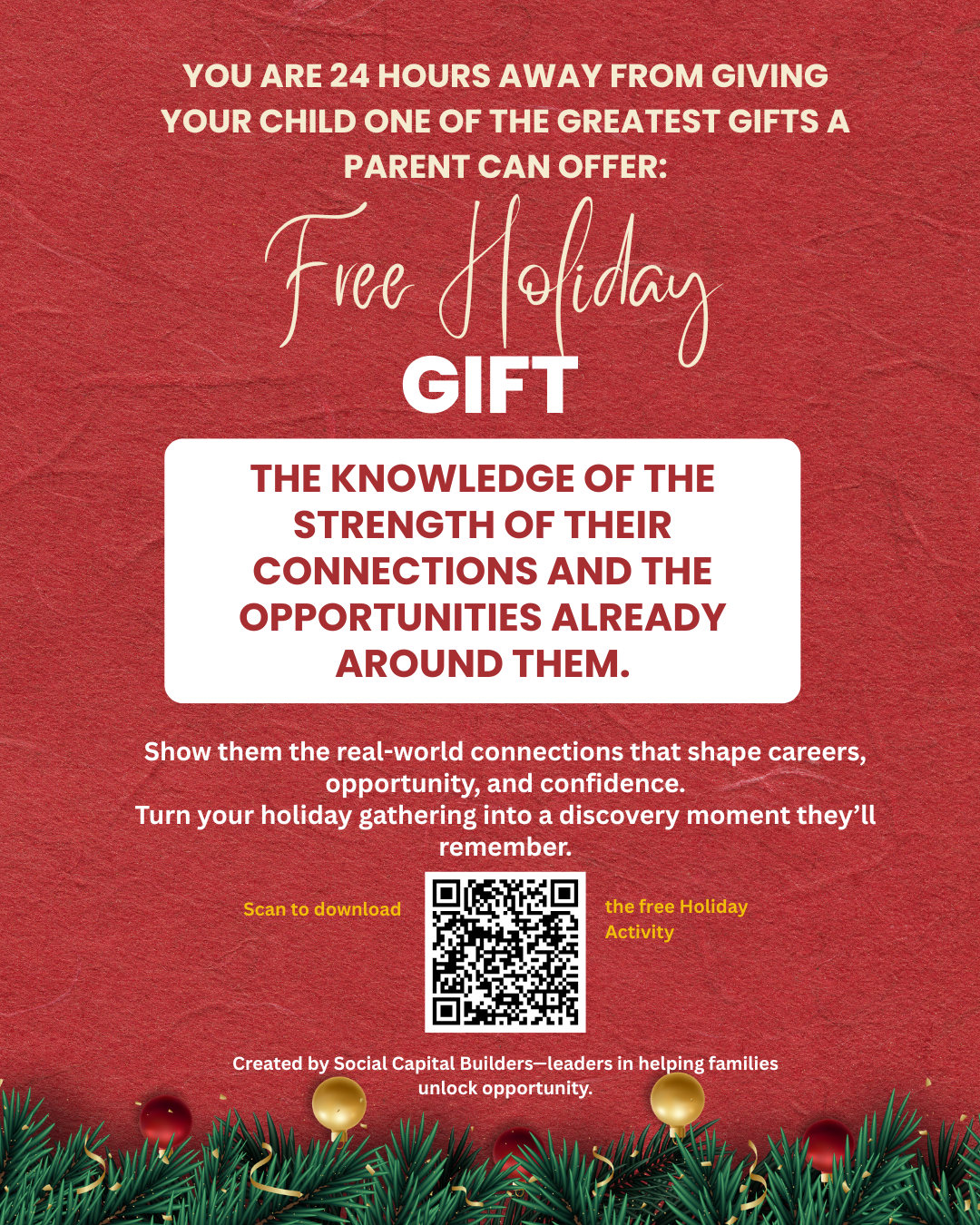
This holiday season, while family is together, you can spend twenty minutes doing a simple social network activity with your child that shows them how connected they already are. Every time I have done this with families, the same thing happens: surprise, hope, a new sense that opportunity might be closer than they thought.
You may think you already know “who you know.” Until you see it on paper, you probably do not.
That is what we are about at Social Capital Smart: helping families see and build the hidden social capital that keeps children not only safe, but opportunity ready.